
In today’s market, TPE and Silicone dominate as the two most widely used materials. Walk into any product category built around flexibility and realism, and you’ll find these two quietly competing behind the curtain.
Why do both exist?
Why do manufacturers continue to choose one over the other?
Because each material solves a different problem. One prioritizes cost and softness. The other prioritizes stability and longevity.
Let’s break it down from the ground up—science, manufacturing, real-world use, and what actually happens after months of ownership.
Why TPE and Silicone Both Dominate the Market
TPE: The Scalable Illusion
Manufacturers choose TPE because:
- It is significantly cheaper to produce
- Easy to mold at scale (plastic-like processing)
- Naturally soft and skin-like without complex engineering
👉 TPE makes high-volume production accessible.
It lowers the barrier between idea and product.
Silicone: The Engineered Standard
Silicone is chosen because:
- It delivers consistent quality
- It holds shape and performance over time
- It aligns with higher safety expectations
👉 Silicone isn’t just a material.
It’s a commitment to controlled performance.
Molecular Truth: Why They Behave So Differently
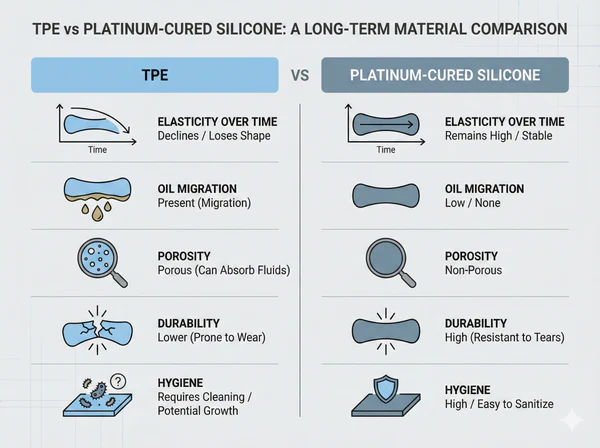
TPE (Thermoplastic Elastomer)
- A blend of polymers + softening oils
- Structure held by physical forces, not permanent bonds
- Can be melted and reshaped
⚠️ Key insight:
TPE relies on added oils to stay soft
Silicone
- Built on a Si–O (siloxane) backbone
- Chemically crosslinked (thermoset structure)
- No need for added softening oils
👉 This single difference explains almost everything that follows.
Price vs Performance Core Trade-Off
| Factor | TPE | Silicone |
|---|---|---|
| Cost | Low | High |
| Manufacturing | Fast, scalable | Slower, precision-based |
| Entry Barrier | Beginner-friendly | Premium tier |
Why TPE Wins on Price
- Injection molding like plastic
- Faster cycle times
- Lower raw material cost
👉 Result: TPE dominates budget and mid-range markets
Feel & Experience: What Users Actually Notice
TPE Experience
- Extremely soft, compressible
- Strong “realistic” feel at first touch
- Warms quickly to body temperature
👉 First impression: impressively lifelike
Silicone Experience
- More elastic than squishy
- Smooth, consistent surface
- Strong rebound and structure
👉 Long-term impression: reliable and controlled
The Hidden Reality of TPE (Critical Long-Term Insight)
Here’s what many guides don’t clearly explain:
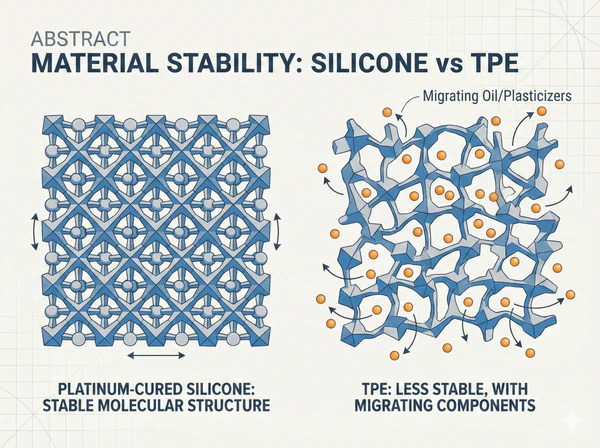
TPE Depends on Internal Oils
To achieve that signature softness, TPE contains added oils (plasticizers).
Over time:
- Repeated use
- Stretching
- Cleaning
➡️ Causes oil migration to the surface
What Happens Next?
1. Oil Leakage
- Surface becomes shiny or sticky
- Feels “sweaty” or greasy
2. Material Drying
- Internal oil content gradually decreases
- Softness fades
3. Structural Degradation
- Increased stiffness
- Cracking or tearing can occur
👉 In simple terms:
TPE slowly loses what makes it feel good
Result: Shortened Lifespan
- Performance declines over time
- Requires more careful maintenance
- Replacement cycle is shorter
Silicone’s Advantage in Real-World Use
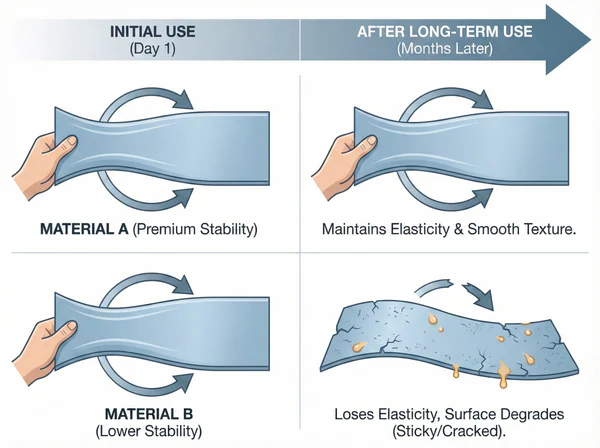
Silicone doesn’t rely on oils.
So it avoids:
- Oil leakage ❌
- Drying out ❌
- Cracking from internal changes ❌
What You Get Instead
- Stable elasticity
- Consistent texture
- Long-term durability
👉 Silicone is chemically stable, not conditionally soft
Platinum Silicone: The Premium Evolution
Not all silicone is equal.
What is Platinum Silicone?
- Cured using a platinum catalyst system
- Produces a cleaner, more complete crosslinking structure
Why Premium Brands Prefer Platinum Silicone
Premium manufacturers choose platinum silicone for one reason:
it removes uncertainty from long-term use
Key Advantages
1. Stretch Stability
- Can be repeatedly stretched
- Returns to original shape without deformation
2. No Oil Dependency
- No internal oils → no leakage
- No gradual drying
3. Structural Integrity
- Resistant to tearing and cracking
- Maintains performance over extended use
4. Higher Purity
- Fewer residual byproducts
- Cleaner material profile
In Practice
Where TPE slowly changes over time,
platinum silicone stays consistent.
👉 It doesn’t “age out” the same way.
For a closer look at how this material performs in real products, you can watch the video below—featuring a platinum silicone piece crafted by Domlust, highlighting its surface detail, structure, and overall design approach.
Final Comparison: Choosing What Fits You
Choose TPE if you value:
- Lower cost
- Ultra-soft initial feel
- Short-term usage
Choose Silicone (Platinum Preferred) if you value:
- Long-term durability
- Stable performance
- No oil leakage or degradation
- Higher material safety
Final Verdict
TPE is designed to feel amazing right now.
Silicone is designed to perform reliably over time.
Platinum silicone takes it further:
It delivers consistency without compromise.
FAQ
Q1:Is TPE safe to use?
A:Yes, but quality varies by manufacturer. Since TPE formulations differ, safety depends on how it is produced and what additives are used.
Q2:Why does TPE become sticky over time?
A:Because it contains internal oils that can migrate to the surface with use, causing a greasy or sticky texture.
Q3:Does silicone ever degrade like TPE?
A:Not in the same way. Silicone does not rely on oils, so it won’t dry out or crack due to internal material loss.
Q4:Is platinum silicone worth the higher price?
A:If you prioritize durability, hygiene, and long-term consistency, yes. It offers a more stable and predictable experience.
Q5:Which material lasts longer?
A:Silicone—especially platinum silicone—generally lasts significantly longer than TPE under regular use.
Q6:Why do cheaper products use TPE?
A:Because it is easier and cheaper to manufacture at scale, making it ideal for budget-friendly products.

